
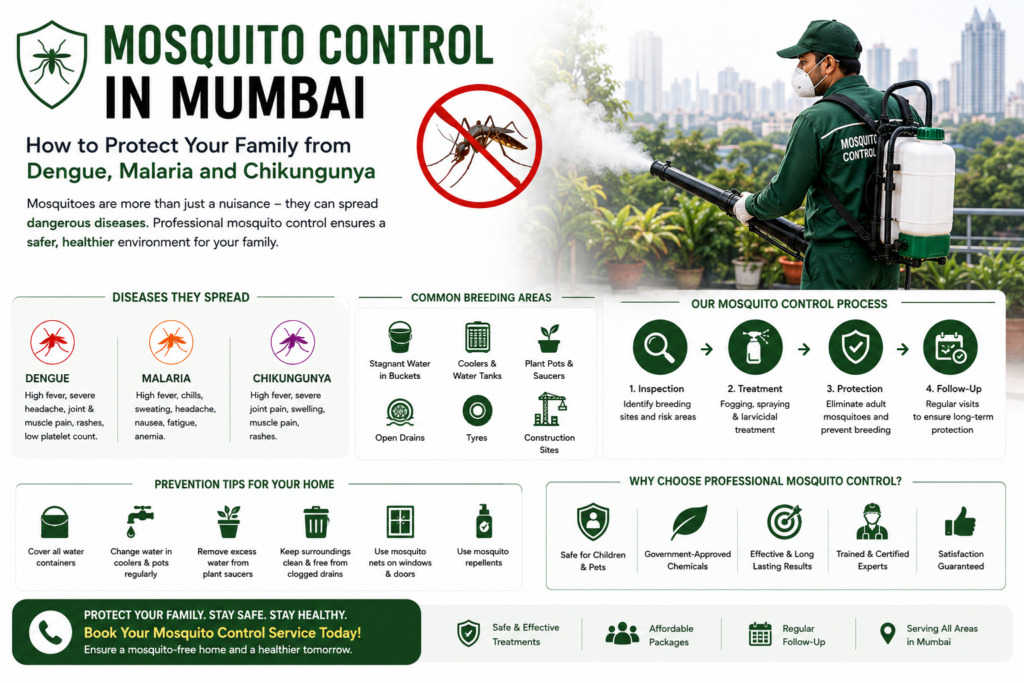
Mosquito Control in Mumbai: How to Protect Your Family from Dengue, Malaria and Chikungunya
Every year, as the monsoon arrives in Mumbai, so does the city’s most dangerous pest. Mosquitoes are not just a nuisance that disrupts sleep and leaves itchy welts on your skin. In Mumbai, they are a genuine public health threat responsible for thousands of cases of dengue, malaria, and chikungunya every single monsoon season. Children, elderly family members, and anyone with a compromised immune system are particularly at risk, and in severe cases, mosquito-borne diseases can be life-threatening.
Most Mumbai residents respond to mosquitoes the same way — with coils, liquid vaporisers, mosquito nets, or repellent sprays. These measures provide some temporary personal protection but do nothing to reduce the mosquito population in and around your home. As long as mosquitoes continue to breed in and near your property, the threat remains active every single day of the monsoon season and often well beyond it.
At Pestcontrol Sine, we provide professional mosquito control services across Mumbai that go beyond surface-level relief to target mosquitoes at every stage of their lifecycle, from breeding sites and larvae to adult populations. This guide covers everything you need to know about mosquito control in Mumbai in 2026, including which species are most dangerous, where they breed, and what professional treatment actually involves.
Why Mumbai Has Such a Severe Mosquito Problem
Mumbai’s combination of climate, geography, and urban infrastructure creates conditions that are almost perfectly designed for mosquito breeding and proliferation.
Mosquitoes breed in stagnant water, which is abundant during the monsoon season and even after heavy rains. The warm and humid climate of Mumbai provides an excellent breeding ground for mosquitoes, making them a significant health risk as carriers of diseases such as dengue, malaria, and chikungunya. Pest Free Services
The problem is compounded by several factors unique to Mumbai. The city’s ageing drainage infrastructure struggles to cope with monsoon rainfall, leading to widespread waterlogging across low-lying areas. Construction sites across the city, of which there are thousands at any given time, accumulate rainwater in excavations, cement mixers, and discarded containers. Overhead water storage tanks on building rooftops are a major breeding site when not properly sealed or maintained. Even small amounts of stagnant water in plant saucers, bottle caps, tyres, and blocked gutters are sufficient for a mosquito to complete its breeding cycle.
Mumbai’s year-round warm temperatures mean that unlike northern Indian cities where mosquito activity drops significantly in winter, Mumbai residents deal with elevated mosquito populations throughout most of the year, with peak activity during and immediately after the monsoon between June and October.
The Three Most Dangerous Mosquito-Borne Diseases in Mumbai
Understanding the health risks posed by Mumbai’s mosquito population is essential context for understanding why professional mosquito control matters.
Dengue Fever
Dengue is the most commonly reported mosquito-borne disease in Mumbai and cases have increased significantly over the past decade. It is transmitted by the Aedes aegypti mosquito, which is a day-biting species that breeds in clean stagnant water in and around homes. Symptoms include sudden high fever, severe headache, pain behind the eyes, joint and muscle pain, rash, and in severe cases haemorrhagic fever that can be fatal without prompt medical treatment.
What makes dengue particularly dangerous in Mumbai is that the Aedes aegypti mosquito breeds in domestic water containers, overhead tanks, flower pots, and other water storage items inside and immediately around people’s homes. This means the mosquitoes responsible for dengue are breeding inside residential buildings rather than in outdoor areas, making personal protection measures particularly important.
Malaria
Malaria in Mumbai is primarily transmitted by the Anopheles mosquito, which breeds in larger bodies of stagnant water including puddles, drains, and construction site excavations. Anopheles mosquitoes are night-biters and peak biting activity occurs between dusk and dawn. Malaria symptoms include high fever with chills and rigors, sweating, headache, vomiting, and fatigue. Without prompt treatment, malaria can progress to severe and life-threatening complications.
Mumbai records thousands of confirmed malaria cases every monsoon season, with certain areas including Dharavi, Govandi, Mankhurd, and parts of the eastern suburbs historically reporting higher incidence rates due to infrastructure and drainage challenges.
Chikungunya
Also transmitted by the Aedes mosquito, chikungunya causes fever and severe joint pain that can persist for weeks or months after the acute illness has resolved. While rarely fatal, the prolonged joint pain and fatigue associated with chikungunya can be severely debilitating, affecting a patient’s ability to work and carry out daily activities for extended periods. Mumbai has seen significant chikungunya outbreaks in multiple monsoon seasons in recent years.
Where Mosquitoes Breed in Mumbai Homes and Buildings
Effective mosquito control begins with identifying and eliminating breeding sites. In a Mumbai home or apartment building, mosquitoes can breed in a surprising number of places that residents often overlook.
Overhead water storage tanks on rooftops are among the most significant breeding sites in Mumbai’s apartment buildings. When tanks are not properly sealed or when lids are broken or missing, they provide an ideal breeding environment for thousands of mosquitoes. Flower pots and plant saucers that collect water are a primary breeding site for Aedes mosquitoes in balconies and gardens. Even a teaspoon of water sitting in a saucer for more than a week is sufficient for a mosquito to complete its breeding cycle. Air conditioning drainage trays and condensation drip points accumulate small amounts of water that are ideal for Aedes mosquito breeding. Blocked or poorly maintained roof gutters hold standing water throughout the monsoon season. Discarded tyres, plastic containers, buckets, and any item that holds water in or around the building creates potential breeding sites. Construction sites adjacent to residential buildings accumulate large quantities of stagnant water in excavations, formwork, and discarded materials. Septic tanks, soak pits, and drainage systems that are not properly sealed or maintained can support large Anopheles mosquito populations.
Why Mosquito Coils, Vaporisers and Repellents Are Not Enough
The vast majority of Mumbai households rely on mosquito coils, electric vaporisers, liquid repellents, or spray-on repellents as their primary mosquito control measures. These products have a role to play in personal protection but they are fundamentally inadequate as a mosquito control strategy for several important reasons.
These products work by repelling mosquitoes from a specific area or killing individual mosquitoes that come into contact with the active ingredient. They do nothing to address the breeding sites that are producing new mosquitoes continuously. Even if every adult mosquito in your flat is killed tonight, new mosquitoes will be hatching and entering your home tomorrow if the breeding sites around your building remain untreated.
Many mosquito coils and vaporisers contain pyrethrin-based compounds that pose their own health risks with prolonged indoor exposure, particularly for children and individuals with respiratory conditions. They are often used continuously through the night in enclosed bedrooms, creating indoor air quality concerns that can outweigh their mosquito control benefit.
Mosquito nets provide good personal protection during sleep but offer no protection during waking hours and do nothing to reduce mosquito populations inside or outside the home.
Professional mosquito control addresses the source of the problem rather than just the symptom, which is the fundamental difference between temporary relief and genuine long-term protection.
Professional Mosquito Control Methods Used in Mumbai
At Pestcontrol Sine, our mosquito control programme combines multiple treatment approaches to deliver comprehensive protection that addresses both existing adult mosquito populations and the breeding sites producing new mosquitoes.
Larvicidal Treatment
This is the most important component of any professional mosquito control programme and targets mosquitoes before they ever become adults capable of biting or transmitting disease. Larvicidal agents are applied to all identified water bodies and potential breeding sites in and around your property, including overhead tanks, drainage systems, plant saucers, construction water accumulations, and any other stagnant water sources.
The larvicide kills mosquito larvae in the water before they can complete their development into adult mosquitoes. Some formulations remain active in the water for several weeks, providing sustained protection through the monsoon season. Larvicidal treatment is safe for use in drinking water storage tanks at the appropriate dosage and does not affect water quality.
Eliminating breeding sites is the single most effective mosquito control measure available. One study estimated that eliminating a single productive breeding site prevents more mosquito bites than protecting against thousands of individual adult mosquitoes.
Indoor Residual Spraying
A residual insecticide is applied to indoor walls, ceilings, and surfaces where adult mosquitoes rest during the day. Mosquitoes that land on treated surfaces absorb a lethal dose of insecticide and die, reducing the indoor adult mosquito population significantly. The residual effect of the chemical lasts for several weeks after application.
Indoor residual spraying is particularly effective against Anopheles mosquitoes, which tend to rest on indoor walls after feeding, and is a core component of malaria control programmes worldwide.
Outdoor Fogging
Fogging involves dispersing a fine mist of insecticide over outdoor areas including gardens, parking areas, surrounding vegetation, and building perimeters. The fog contacts and kills adult mosquitoes resting in vegetation and outdoor spaces around your property. Fogging provides immediate knockdown of adult mosquito populations and delivers fast visible results.
Fogging is most effective when carried out in the early morning or evening when mosquitoes are most active and when wind speeds are low to ensure the fog disperses evenly through the target area. It is not a standalone solution as it has no effect on larvae or eggs, but combined with larvicidal treatment it provides comprehensive control of both existing adult populations and future generations.
Source Reduction and Site Proofing
This involves identifying and physically eliminating or treating all potential breeding sites in and around your property. Our technicians will assess your building thoroughly and recommend practical measures to reduce or eliminate standing water, including improving drainage, recommending tank lid repair or replacement, treating areas that cannot be drained with appropriate larvicides, and advising on landscaping or structural changes that reduce water accumulation.
Source reduction is the most sustainable long-term mosquito control strategy and is an essential part of every professional mosquito control programme we deliver.
Mosquito Control for Apartment Buildings and Housing Societies in Mumbai
Individual flat treatments provide valuable protection for residents but are significantly more effective when carried out as part of a building-wide or society-wide programme. This is because mosquito breeding sites in common areas, rooftop tanks, basement drainage, and the building perimeter affect all residents equally. Treating one flat while leaving the rest of the building untreated is like fixing one window in a room with ten broken ones.
At Pestcontrol Sine, we offer comprehensive mosquito control programmes for residential housing societies, apartment complexes, and commercial buildings across Mumbai. Our society programmes include treatment of all common areas, rooftop tanks, drainage systems, gardens, parking areas, and building perimeters, combined with individual flat treatments for participating residents.
A society-wide approach is significantly more cost-effective per household than individual treatments and delivers far superior results. We work with society management committees to design programmes that fit within society maintenance budgets and provide complete documentation of all treatments carried out.
Mosquito Control for Commercial Properties in Mumbai
Businesses across Mumbai have a particular responsibility to control mosquito populations on their premises. Restaurants, food courts, hotels, hospitals, schools, offices, and retail establishments all have legal and ethical obligations to provide a safe environment for customers, guests, patients, students, and employees.
For commercial clients, Pestcontrol Sine designs customised mosquito control programmes that comply with relevant regulatory requirements, are scheduled to minimise disruption to business operations, and include full treatment documentation for compliance and audit purposes. We provide dedicated account management for all commercial clients and offer rapid response treatments when required.
How Often Should You Get Professional Mosquito Treatment in Mumbai
It is recommended to schedule pest control services every three to six months to keep your property genuinely pest-free. The exact frequency depends on the level of infestation and the specific pest involved. Techsquadteam
For mosquito control specifically in Mumbai, we recommend a pre-monsoon treatment carried out in May or early June before the rains begin, followed by treatments at four to six week intervals through the monsoon season from June to October. A post-monsoon treatment in October or November addresses any residual breeding sites and adult populations before the season closes.
For high-risk properties or areas with historically elevated mosquito pressure, more frequent treatments during peak monsoon months may be recommended.
How Much Does Mosquito Control Cost in Mumbai
For a residential apartment in Mumbai, mosquito control treatment typically starts at around ₹1,200 for a one-bedroom unit and ranges up to ₹3,500 or more for a larger 3BHK property depending on the treatment methods used and the size of the surrounding area to be treated. VSG Pest Control
Society-wide and commercial programmes are priced based on the total area to be treated and the frequency of visits. At Pestcontrol Sine, we provide detailed written quotes for all programmes after an initial inspection of the property, with no hidden charges and transparent per-visit pricing for all AMC contracts.
Mosquito Prevention Tips for Mumbai Homes
Professional treatment delivers the best results when combined with good habits at home. Here are the most effective steps Mumbai residents can take to reduce mosquito breeding around their homes.
Empty and scrub all water storage containers including buckets, drums, and overhead tanks at least once a week during the monsoon season, as mosquito eggs can survive on dry container walls and hatch when water is added again. Keep all water storage tanks tightly covered with intact, properly fitting lids. Empty flower pot saucers and plant trays at least twice a week or fill them with sand to prevent water accumulation. Ensure all window and door screens are intact with no holes or gaps. Keep air conditioning drainage trays clean and ensure they drain properly. Clear blocked roof gutters before and during the monsoon season. Remove all discarded tyres, containers, and any item that could collect water from in and around your building. Use mosquito-proof covers on septic tanks and soak pits. Keep swimming pools, ornamental ponds, and water features treated with appropriate larvicides or stocked with larvivorous fish that consume mosquito larvae.
Why Choose Pestcontrol Sine for Mosquito Control in Mumbai
At Pestcontrol Sine, our mosquito control programme is designed to deliver genuine long-term protection for Mumbai families and businesses, not just temporary relief. We combine larvicidal treatment, indoor residual spraying, and outdoor fogging into a comprehensive programme that addresses every stage of the mosquito lifecycle and every potential breeding site on your property.
Our technicians are certified and experienced in Mumbai’s specific mosquito species and seasonal patterns. Every programme begins with a thorough site inspection, and we provide detailed treatment reports after every visit so you know exactly what was done and where.
We serve all areas of Mumbai including Andheri, Bandra, Borivali, Kandivali, Malad, Goregaon, Jogeshwari, Santacruz, Kurla, Ghatkopar, Mulund, Bhandup, Thane, Navi Mumbai, Vashi, Panvel, Dadar, Parel, Lower Parel, Worli, Chembur, Colaba, and South Mumbai.
Book Your Free Mosquito Control Inspection Today
Do not wait for dengue season to be in full swing before taking action. The best time to get professional mosquito control treatment in Mumbai is before the monsoon begins, so that your home and family are protected from the moment the rains arrive.
Visit pestcontrolsine.in or call us today to book your free inspection. Our team will assess your property, identify all active and potential breeding sites, and design a mosquito control programme that keeps your family protected through Mumbai’s entire monsoon season and beyond.
Dengue, malaria, and chikungunya are preventable diseases. Professional mosquito control is one of the most direct and effective ways to protect your family from them. Let Pestcontrol Sine make your home a genuinely safe place to live.
Pestcontrol Sine — Professional Mosquito Control Services Across Mumbai