
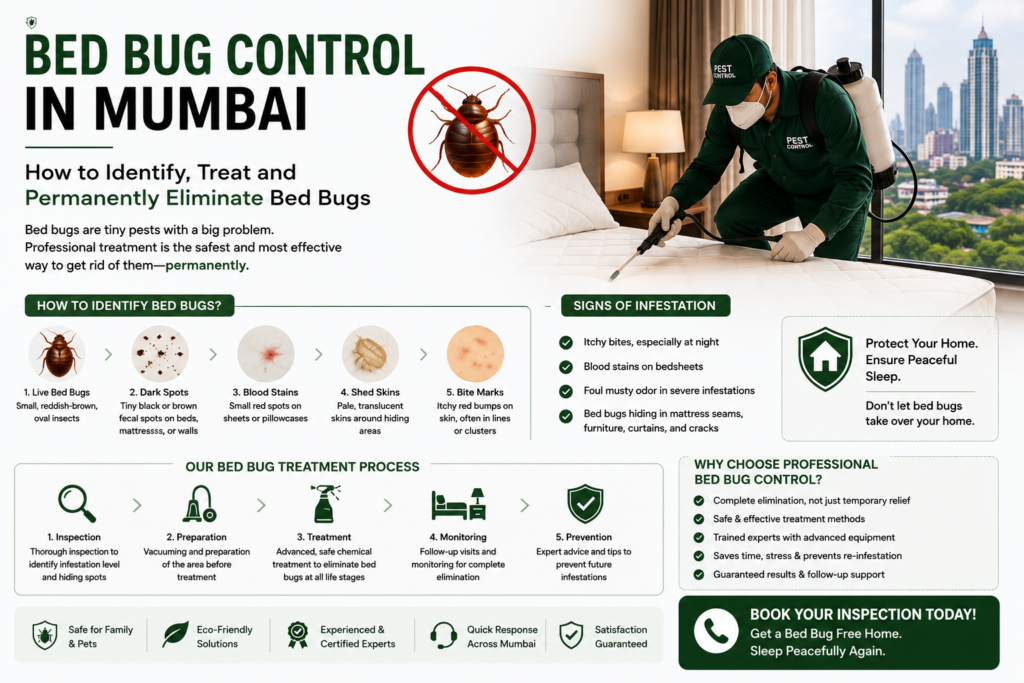
Bed Bug Control in Mumbai: How to Identify, Treat and Permanently Eliminate Bed Bugs
There is perhaps no pest more psychologically disturbing than the bed bug. Unlike cockroaches that scatter when the lights come on or mosquitoes that buzz around visibly, bed bugs operate in complete silence. They hide in the seams of your mattress, the joints of your bed frame, and the folds of your curtains, emerging only at night to feed on sleeping humans before retreating back into hiding before dawn. Many Mumbai residents live with a bed bug infestation for weeks or even months without realising what is causing their itchy, sleepless nights.
Bed bug cases across Mumbai have increased significantly in recent years. The combination of dense housing, frequent travel, second-hand furniture purchases, and the widespread use of shared accommodation has created ideal conditions for bed bugs to spread rapidly from one home to another. And unlike many other pests, bed bugs have nothing to do with how clean or dirty your home is. They are opportunistic hitchhikers that travel on luggage, clothing, and furniture, and they can infest the most immaculate home just as easily as a neglected one.
At Pestcontrol Sine, we have helped hundreds of Mumbai families and hospitality businesses eliminate bed bug infestations completely. This guide covers everything you need to know about bed bugs in Mumbai in 2026, from identifying the earliest signs of an infestation to understanding what professional treatment actually involves and how long it takes to work.
What Are Bed Bugs and Why Are They So Hard to Eliminate
Bed bugs are small, oval-shaped, reddish-brown insects that feed exclusively on blood, preferring human blood above all other hosts. Adult bed bugs are roughly the size of an apple seed, approximately five to seven millimetres in length, and are flat when unfed, which allows them to squeeze into extraordinarily thin gaps and crevices. After feeding, their bodies swell and become more elongated.
What makes bed bugs particularly difficult to eliminate is a combination of biological and behavioural factors that set them apart from almost every other common household pest.
They reproduce slowly relative to cockroaches or mosquitoes, but consistently. A single female bed bug lays between one and five eggs per day and up to 500 eggs over her lifetime. Eggs hatch in six to ten days and reach reproductive maturity within five weeks, meaning a small undetected population can grow into a large infestation within a single monsoon season.
Bed bugs can survive without feeding for three to six months under normal temperature conditions, and some studies suggest they can survive even longer in cooler environments. This means that even if you vacate a property for several months, returning bed bugs may still be waiting for you. They are also resistant to many common insecticides, making over-the-counter treatments largely ineffective against established infestations.
Most significantly, bed bugs are expert hiders. They spend approximately 90 percent of their time concealed in cracks, crevices, and voids, only emerging to feed. This makes visual detection difficult and makes surface spray treatments inadequate as a standalone solution.
Why Bed Bugs Are a Growing Problem in Mumbai
Bed bugs are a common problem in residential and hospitality settings across Mumbai, discreetly infesting mattresses, furniture, and crevices. Rentokil Pest Control India
Several factors specific to Mumbai contribute to the growing prevalence of bed bug infestations across the city.
International and domestic travel is a primary driver. Mumbai is one of India’s busiest travel hubs, and bed bugs are among the most efficient hitchhikers in the insect world. They cling to luggage, bags, and clothing in infested hotel rooms and travel home with unsuspecting guests. A single night in an infested hotel room is enough to introduce bed bugs to a previously clean home.
The popularity of second-hand and refurbished furniture is another major factor. Mumbai has a thriving market for second-hand sofas, beds, mattresses, and wardrobes, particularly in areas like Chor Bazaar and through online marketplaces. Bringing infested furniture into your home is one of the most common ways a bed bug infestation begins.
Shared accommodation, paying guest facilities, and hostels, which are extremely common across Mumbai’s working population, create environments where bed bugs spread easily between residents and rooms. Dense apartment buildings with shared walls and common areas also facilitate the movement of bed bugs between neighbouring flats through electrical conduits and wall voids.
How to Identify a Bed Bug Infestation
Because bed bugs are nocturnal and spend most of their time hidden, many people do not realise they have an infestation until it has already grown significantly. Knowing what to look for is the key to early detection.
The most common early sign is unexplained bites appearing on your skin after sleeping. Bed bug bites typically appear in clusters or a line pattern, often on exposed skin such as the arms, shoulders, neck, and face. They are raised, red, and intensely itchy, and may take several hours or even days to appear after the bite occurs. However, bites alone are not a reliable indicator since not all people react visibly to bed bug bites, and bites from mosquitoes or other insects can look similar.
Look for small dark brown or black spots on your mattress seams, bed frame joints, headboard, and bedside furniture. These spots are bed bug excrement and are one of the most reliable signs of an active infestation. The spots are roughly the size of a pen tip and may smear if wiped with a damp cloth.
Check the seams and folds of your mattress for shed skins, which are translucent yellowish shells left behind as bed bugs grow through their five nymph stages before reaching adulthood. Also look for tiny white oval eggs, approximately one millimetre in length, in the same areas.
A sweet, musty odour in the bedroom, sometimes described as similar to coriander or almonds, is produced by bed bugs in large numbers and is a sign of a well-established infestation. By the time this odour is noticeable, the infestation is usually already severe.
Finally, look for live bed bugs themselves. Pull back the mattress seams, check under the mattress, inspect the joints and undersides of the bed frame, look behind the headboard if it is wall-mounted, check behind picture frames and wall sockets near the bed, and inspect the folds of curtains near sleeping areas.
Health Effects of Bed Bug Infestations
While bed bugs are not known to transmit diseases directly, the health impact of a bed bug infestation can be significant and should not be underestimated.
The most immediate effect is disrupted sleep. People living with an active bed bug infestation frequently report chronic sleep deprivation due to the anxiety of knowing they will be bitten during the night. This leads to fatigue, difficulty concentrating, irritability, and reduced productivity.
Skin reactions to bed bug bites range from mild itching and redness to severe allergic reactions requiring medical treatment in some individuals. Repeated scratching of bites can cause secondary skin infections. Children and elderly individuals tend to have stronger skin reactions than younger adults.
The psychological impact of a bed bug infestation is well documented. Many sufferers report significant anxiety, stress, and in some cases symptoms of post-traumatic stress disorder following a severe infestation. The feeling of being bitten while sleeping in your own bed is deeply unsettling, and the fear that the infestation may have spread to other rooms or returned after treatment can persist long after the bugs themselves are gone.
For these reasons, bed bug infestations should be treated as a genuine health emergency rather than a minor inconvenience.
Why DIY Bed Bug Treatments Always Fail
If you search online for bed bug remedies, you will find dozens of suggested approaches. Spraying with pyrethrin-based insecticides, applying diatomaceous earth, using essential oils, washing bedding at high temperatures, and sealing mattresses in plastic covers are among the most commonly recommended DIY solutions. Most of these provide some partial relief but fail to eliminate the infestation completely.
The reason is straightforward. Bed bugs hide in areas that surface treatments cannot reach. Spraying the surface of a mattress does nothing to the bugs hiding inside the bed frame joints, behind the headboard, inside electrical sockets, or within wall voids. Washing and drying bedding kills bugs present on the bedding itself but does nothing to the rest of the infestation. Diatomaceous earth works slowly and only on bugs that walk through it, leaving the majority of the population unaffected.
Most critically, bed bugs have developed significant resistance to many of the active ingredients in common over-the-counter insecticides in India. Using these products repeatedly without eliminating the infestation simply selects for the most resistant individuals, making the population progressively harder to control over time.
Professional treatment is the only reliable way to eliminate a bed bug infestation completely.
Professional Bed Bug Treatment Methods Used in Mumbai
At Pestcontrol Sine, we use a combination of proven professional methods to eliminate bed bug infestations at every life stage, including eggs, nymphs, and adults, in a single treatment programme.
Chemical Treatment with Residual Insecticide
This is the most widely used professional bed bug treatment in Mumbai and delivers reliable results when applied correctly by trained technicians. A combination of contact insecticides and residual sprays is applied to all hiding areas including mattress seams, bed frame joints, headboards, bedside furniture, skirting boards, behind wall sockets and switch plates, curtain folds, and any wall cracks or crevices near the sleeping area.
The contact insecticide kills bed bugs on immediate exposure while the residual chemical remains active on treated surfaces for several weeks, killing bugs that emerge from deeper hiding spots after the initial treatment. Multiple visits are typically required to catch newly hatched nymphs that were in the egg stage during the first treatment and are therefore unaffected by insecticides.
Steam Treatment
High-temperature steam is applied directly to mattress seams, bed frame joints, furniture, and other hiding areas. Bed bugs at all life stages, including eggs, are killed instantly on contact with steam at temperatures above 55 degrees Celsius. Steam treatment is chemical-free, leaves no residue, and is safe for use around children and pets. It is particularly effective for treating mattresses and upholstered furniture where chemical application may not be desirable.
Steam treatment is most effective when used in combination with chemical treatment rather than as a standalone solution, as the steam penetration depth is limited and may not reach bugs hiding deep within wall voids or furniture cavities.
Heat Treatment
Heat treatment involves raising the temperature of the infested room or area to between 49 and 57 degrees Celsius using specialised heating equipment and maintaining that temperature for a sufficient period to kill all bed bugs and eggs throughout the treated space. This is a chemical-free method that penetrates into wall voids, mattress interiors, and furniture where spray treatments cannot reach.
Heat treatment is considered one of the most effective single-session bed bug treatments available and is particularly useful for severe infestations or situations where chemical use is not preferred. It is more expensive than chemical treatment but can achieve complete elimination in a single visit.
Mattress Encasements
After treatment, fitting a bed bug-proof encasement over the mattress and box spring traps any surviving bugs inside where they eventually die, prevents re-infestation of the mattress surface, and makes future monitoring much easier. We recommend encasements as a standard post-treatment precaution for all our bed bug clients.
How Many Treatment Sessions Are Required
The number of sessions required depends on the severity of the infestation and the treatment method used.
For a mild to moderate infestation treated with chemical spray, a minimum of two sessions is typically required, spaced two to three weeks apart. The first session kills active bugs and those that emerge shortly after. The second session targets newly hatched nymphs that were in the egg stage during the first treatment. For a severe infestation, three sessions may be needed.
Heat treatment or steam treatment combined with chemical treatment can often achieve satisfactory results in fewer sessions. Our technicians will assess your specific situation during the free inspection and recommend the most appropriate treatment plan for your home.
It is recommended to schedule follow-up pest control visits every three to six months to keep your property genuinely pest-free throughout the year. Techsquadteam
How Much Does Bed Bug Treatment Cost in Mumbai
A single-bedroom apartment bed bug treatment in Mumbai typically costs between ₹1,200 and ₹3,000, while a larger 3BHK or above may range from ₹3,500 to ₹6,000 depending on the severity of the infestation and the treatment method used. VSG Pest Control
At Pestcontrol Sine, our bed bug treatment pricing is fully transparent with no hidden charges. We provide a written quote after the free site inspection and offer a re-treatment guarantee if bed bugs return within the guarantee period.
What to Do Before Your Bed Bug Treatment
Preparation is critical to the success of a professional bed bug treatment. Here is what to do before our technicians arrive.
Strip all bedding including sheets, pillowcases, mattress covers, and duvet covers and wash them at the highest temperature the fabric allows. Dry them on the highest heat setting and seal them in clean plastic bags until after the treatment is complete. Clear all clutter from under the bed and around bedroom furniture to give technicians full access to all hiding areas. Remove all clothing from wardrobes and drawers in the treatment room and wash or bag them securely. Pull the bed away from the wall to allow full access to the headboard and all sides of the bed frame. Vacate the premises with all family members and pets for the duration of the treatment and for the time recommended by your technician, typically four to six hours for a chemical treatment.
Bed Bug Prevention Tips for Mumbai Homes
Once your home is bed bug-free, these precautions significantly reduce the risk of re-infestation.
When returning from any travel, inspect your luggage thoroughly before bringing it inside. Ideally, unpack directly into the washing machine and store suitcases away from the bedroom. Avoid placing luggage on hotel beds or carpeted floors during travel. Always inspect second-hand furniture, mattresses, and clothing carefully before bringing them into your home. If buying a second-hand bed or sofa in Mumbai, have it professionally inspected or treated before use. Use bed bug-proof mattress encasements on all beds in your home. Regularly vacuum your mattress seams, bed frame, and surrounding area and dispose of the vacuum bag immediately afterwards. When staying in hotels or paying guest accommodation, inspect the mattress seams and headboard before sleeping and keep luggage elevated off the floor on a luggage rack.
Bed Bug Control for Hotels, Guest Houses and Paying Guest Accommodation in Mumbai
Bed bugs are a particularly serious issue for Mumbai’s hospitality sector. A single guest complaint about bed bugs can result in negative reviews that damage a property’s reputation for months or years. For hotels, guest houses, service apartments, and paying guest facilities, a proactive bed bug management programme is not just good practice — it is a business necessity.
At Pestcontrol Sine, we offer customised bed bug management contracts for commercial hospitality clients across Mumbai. Our programmes include regular scheduled inspections, preventive treatments, staff training on early detection, and rapid response treatments when an infestation is identified. All treatments are carried out discreetly with minimal disruption to guests and operations.
Why Choose Pestcontrol Sine for Bed Bug Control in Mumbai
At Pestcontrol Sine, we understand how distressing a bed bug infestation can be. Our approach is thorough, discreet, and focused entirely on delivering permanent results rather than temporary relief. Every treatment begins with a detailed inspection of all potential hiding areas, followed by a customised treatment plan that targets every life stage of the infestation.
We use only professional-grade insecticides applied by certified technicians. Every bed bug treatment comes with a written service guarantee, and we offer flexible scheduling including weekend and evening appointments to suit your routine.
We cover all areas of Mumbai including Andheri, Bandra, Borivali, Kandivali, Malad, Goregaon, Thane, Navi Mumbai, Vashi, Kurla, Ghatkopar, Mulund, Dadar, Parel, Lower Parel, Worli, Chembur, Colaba, and South Mumbai.
Book Your Free Bed Bug Inspection Today
If you are waking up with unexplained bites, noticing dark spots on your mattress, or simply suspect you may have a bed bug problem, do not wait. Bed bug infestations grow steadily over time and become progressively harder and more expensive to treat the longer they are left.
Visit pestcontrolsine.in or call us today to book your completely free bed bug inspection. Our certified technicians will carry out a thorough assessment of your bedroom and surrounding areas, confirm whether bed bugs are present, and recommend the most effective treatment plan for your specific situation with full transparent pricing before any work begins.
A good night’s sleep in your own home is something every Mumbai family deserves. Let Pestcontrol Sine help you get it back.
Pestcontrol Sine — Professional Bed Bug Control Services Across Mumbai